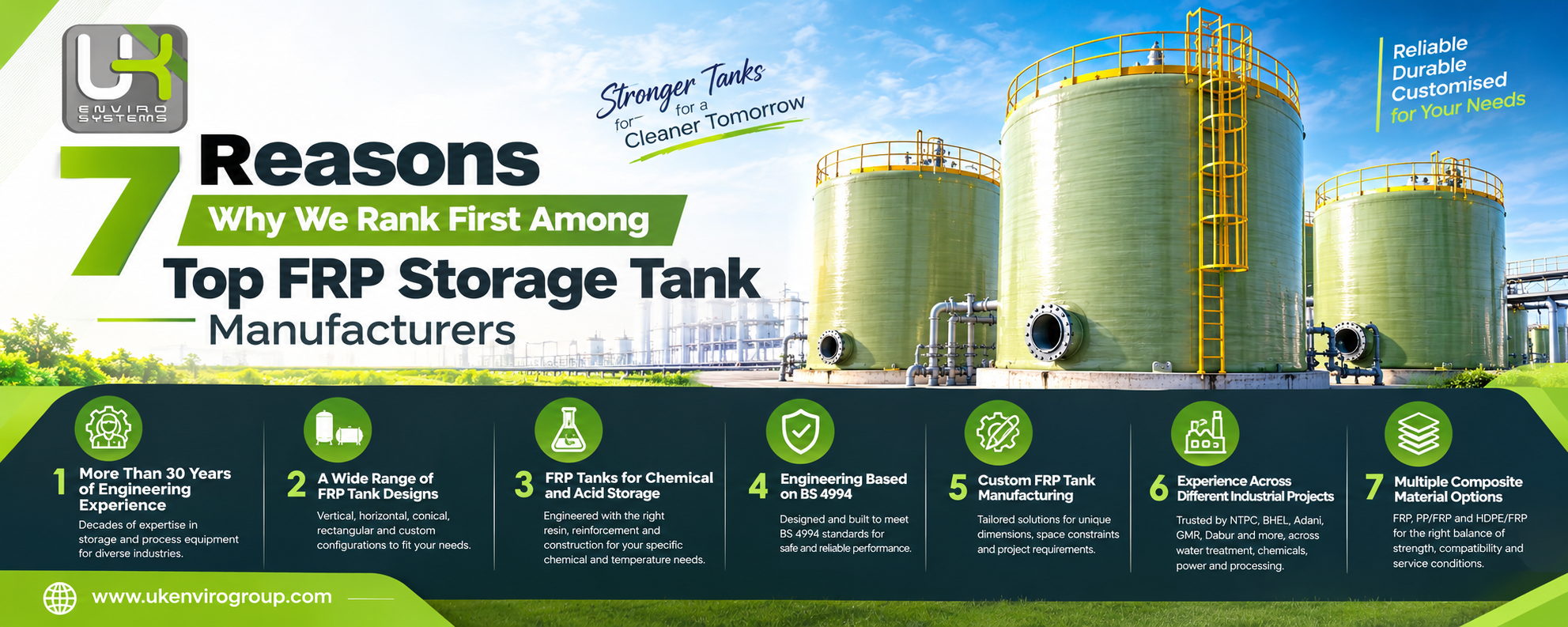
When you're storing chemicals, acids, wastewater or other aggressive liquids, choosing the right tank is about more than just getting the required capacity. The material, resin system, reinforcement, design and fabrication all have a bearing on how well the tank performs over time. That's where FRP storage tanks have found their place in many industrial applications. They offer corrosion resistance and can be designed in different shapes, sizes and configurations to suit specific plant requirements. But there is no universal FRP tank that works for every application. The right choice depends on what you're storing, its concentration and temperature, the required capacity, available installation space and the conditions under which the tank will operate. With more than three decades of engineering experience, UK Enviro Systems provides FRP storage tank solutions for a range of industrial requirements. Its product range includes chemical and acid storage tanks, process tanks, STP tanks, conical-bottom tanks and customised composite tanks. Here are seven factors that set UK Enviro Systems apart in the FRP storage tank industry in India.
1. More Than 30 Years of Engineering Experience
When an FRP tank is going into a demanding industrial environment, experience matters.
UK Enviro Systems has more than 30 years of engineering experience in storage and process equipment. Over the years, the company has worked on requirements across different industrial applications, giving it exposure to a wide range of operating conditions.
That experience is useful because designing a tank involves much more than deciding how many litres it should hold. The stored material, chemical compatibility, tank configuration, operating conditions and installation requirements all need to be considered.
For buyers, having these factors evaluated early can make the tank selection and specification process much easier.
2. A Wide Range of FRP Tank Designs
Every industrial facility has its own layout and limitations. Sometimes there is plenty of space; sometimes there is barely enough room to manoeuvre. A standard tank design may not always fit the job.
UK Enviro Systems manufactures FRP tanks in several configurations, including:
● Vertical cylindrical tanks
● Horizontal cylindrical tanks
● Conical-bottom tanks
● Rectangular tanks
● Custom-designed FRP tanks
The configuration can be selected according to the required capacity, available space, process requirements and installation conditions. This is particularly helpful for projects where the new tank has to be integrated into an existing plant rather than installed in a completely new facility.
3. FRP Tanks for Chemical and Acid Storage
Chemical storage is one area where choosing the right tank construction becomes particularly important.
Different chemicals can behave differently when they come into contact with a tank material. Concentration and operating temperature can also affect material compatibility. So, simply deciding to use an FRP tank isn't the end of the selection process.
The resin system, reinforcement and overall construction need to be considered based on what the tank will actually store.
UK Enviro Systems manufactures FRP chemical and acid storage tanks for industrial applications, with the intended service conditions considered during the engineering process.
If you're planning a chemical storage tank, it helps to provide the manufacturer with details such as the chemical name, concentration, operating temperature, specific gravity and required capacity. These details can make a significant difference to the final tank specification.
4. Engineering Based on BS 4994
Industrial tanks need a sound engineering basis, especially when they're going to handle corrosive or demanding fluids.
UK Enviro Systems provides FRP tank engineering based on BS 4994 requirements. The standard covers the design and construction of reinforced plastics vessels and tanks.
Working to an established engineering standard provides a structured approach to tank design. It can also make technical discussions between the manufacturer, engineering team and buyer clearer.
Of course, the standard alone doesn't determine whether a tank is suitable for a particular application. The actual operating conditions, stored material, dimensions and other project requirements still need to be assessed.
5. Custom FRP Tank Manufacturing
Not every industrial project can accommodate a standard tank. A plant may have restricted space, unusual dimensions, specific nozzle locations or particular support requirements.
That's where custom manufacturing becomes useful.
UK Enviro Systems provides customised FRP tank solutions based on individual project requirements. Dimensions, configuration and other construction details can be considered according to the application and site conditions.
For larger tanks, transportation can also become a practical issue. In such cases, the manufacturing and installation approach may be planned around the site itself rather than simply delivering a completely fabricated tank.
This can be particularly useful for projects where access, transportation or installation space is limited.
6. Experience Across Different Industrial Projects
FRP tanks are used across a wide range of industries, from water treatment and chemicals to power generation and industrial processing.
UK Enviro Systems has worked on projects associated with organisations including NTPC, BHEL, Adani, GMR and Dabur.
Its project experience includes requirements related to chemical storage, industrial processing, water treatment and other applications where composite storage equipment is required.
Every project comes with its own set of practical considerations. Tank capacity may be only one part of the equation. Site conditions, stored material, process requirements, installation method and operating environment can all influence the final design.
Experience across different types of projects can therefore be useful when discussing a new tank requirement.
7. Multiple Composite Material Options
FRP isn't necessarily the only construction option for every industrial storage requirement.
Depending on the application, a tank may require a composite construction using different materials. UK Enviro Systems offers manufacturing capabilities for FRP, PP/FRP and HDPE/FRP configurations.
Having these options allows the tank construction to be considered around the actual service conditions rather than treating every application in exactly the same way.
Factors such as chemical compatibility, operating temperature, mechanical requirements and the properties of the stored liquid should be evaluated before deciding on the appropriate construction.
Conclusion
UK Enviro Systems brings more than 30 years of engineering experience to the design and manufacture of FRP storage tanks. Its capabilities cover chemical and acid storage tanks, process tanks, STP tanks, conical-bottom tanks and customised tank solutions.
The company also offers FRP, PP/FRP and HDPE/FRP construction options, allowing tank specifications to be considered according to different applications and operating conditions.